
Sumba Ikat Wall Hanging Size Guide for Interiors
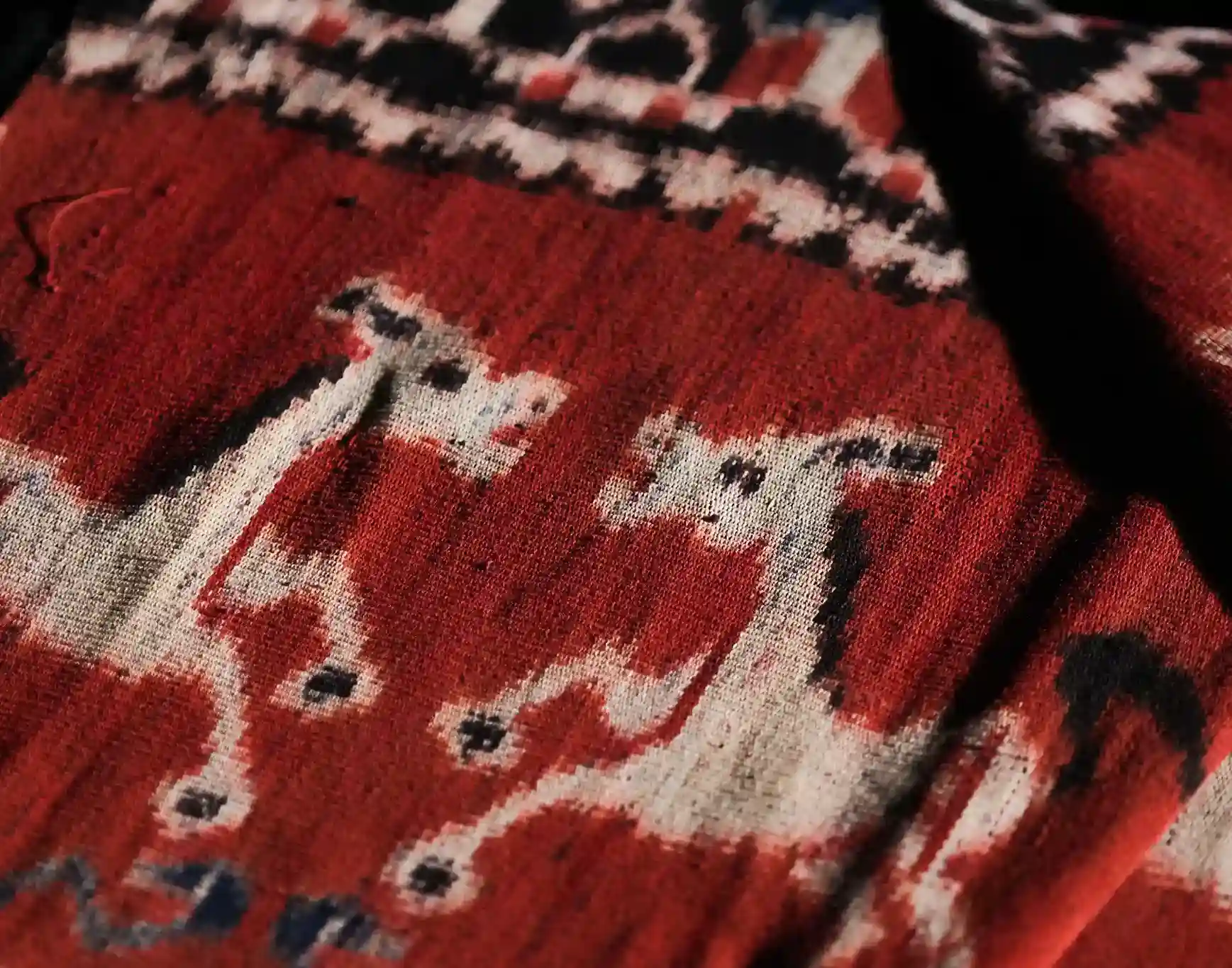
A Sumba ikat wall hanging should span roughly two-thirds to three-quarters of the width of the furniture it sits above, and be mounted so the centre of the cloth falls about 145 to 152 centimetres from the floor, which is the standard eye-level height galleries use for hanging work.
Those two numbers solve most of the sizing decisions interior designers face, but they interact with a constraint specific to this textile: a single handwoven panel from a backstrap loom is only about 45 to 70 centimetres wide, so wider pieces are two panels joined at a centre seam. Sizing a Sumba ikat installation means working with that geometry rather than around it.
How big should the piece be for the wall?
Start from the furniture, not the wall. A textile hung above a sofa, console, or headboard reads as part of that group, and the two-thirds to three-quarters proportion is what makes the pairing look deliberate rather than accidental. A piece narrower than half the furniture width looks stranded; one wider than the furniture makes the furniture look undersized.
| Position | Typical furniture width | Target cloth width | Panels needed |
|---|---|---|---|
| Above a two-seat sofa | 160 cm | 105 to 120 cm | Two joined panels |
| Above a three-seat sofa | 210 cm | 140 to 160 cm | Two wide panels or three joined |
| Above a king headboard | 180 cm | 120 to 135 cm | Two joined panels |
| Above a console table | 120 cm | 80 to 90 cm | One wide panel or two narrow |
| Narrow pier or between windows | 60 to 80 cm | 45 to 60 cm | One panel |
| Stairwell or double-height wall | Not furniture-led | Height-led, 200 cm and up | Two panels, vertical hang |
Where does the centre seam belong?
A traditional hinggi is woven as two mirror-symmetrical halves joined along the middle, so the seam usually falls exactly on the vertical centre line of the design and reads as part of the composition. Fighting it produces awkward results; centring it produces a symmetrical piece that anchors a wall cleanly.
For asymmetric compositions, or where a cloth is cut down for a specific opening, decide the seam position at the specification stage rather than at installation. If a seam must sit off-centre, place it deliberately at a third of the width so it reads as a design line. Buyers commissioning larger statement pieces can see how these joins are planned in the premium Sumba ikat cloth for luxury interiors range.
What are the standard formats to work from?
A full hinggi is commonly somewhere around 110 to 130 centimetres wide by 250 to 270 centimetres long, which makes it a natural fit for a full-height feature panel or a generous horizontal hang above a large sofa. Smaller traditional formats give designers a set of usable modules below that.
- Full hinggi: feature wall, stairwell, double-height space, or dramatic headboard backdrop.
- Half-length piece: above a standard sofa or console, hung horizontally.
- Single panel, unjoined: narrow pier, corridor, powder room, or between windows.
- Framed fragment: guest room, corridor, or a repeated element across many rooms.
- Paired panels: flanking a bed, doorway, or fireplace, using the mirror symmetry of a pair.
Horizontal or vertical: which orientation works better?
Sumba ikat motifs are usually organised in bands running across the cloth, so orientation changes how the pattern reads, and the traditional viewing direction is not always the one that suits the room. Neither choice is wrong, but the decision should be conscious.
Hang horizontally when the piece sits above furniture and needs to echo a horizontal line. Hang vertically in stairwells, narrow walls, and double-height spaces where the eye travels upward. Where a piece contains directional figures such as horses or human forms, check that the vertical orientation does not leave them lying on their side, which usually looks unintentional to anyone familiar with the tradition.
How should the textile actually be mounted?
Textile conservators mount cloth using a hook-and-loop strip stitched to a fabric-covered board so the weight is carried evenly along the whole top edge, and that principle matters more than any decorative consideration. Hanging a heavy handwoven cloth from a few clips or nails concentrates load at those points and will eventually tear the weave.
- Hook-and-loop mount: strip sewn to a facing tape, mated to a board fixed to the wall, for even load spread.
- Rod in a sleeve: a stitched channel along the top edge carrying a rod, also spreading load along the edge.
- Batten stretch: cloth wrapped and stapled to a padded frame for a flat, permanent panel.
- Box frame with glazing: best protection for fragile or high-value pieces, using ultraviolet-filtering glass.
- Avoid entirely: bulldog clips, single nails, adhesives, and pins through the weave.
What light and climate does the wall need?
Museums generally keep textiles below about 50 lux of light and at a relative humidity in the mid-forties to mid-fifties, and while a home or hotel cannot be run as a store room, the direction of travel is clear: less direct light means slower fading. Natural dyes in particular lose depth under sustained ultraviolet exposure.
In practice this means avoiding walls that receive direct sun for part of the day, keeping picture lights at a distance rather than close and hot, and using ultraviolet-filtering glazing where a piece is framed. Bathrooms and unventilated basements are poor choices because humidity swings encourage mould. Where a client insists on a bright wall, plan to rotate two pieces so neither takes the full exposure. Practical selection guidance for specific rooms is set out on our Sumba ikat wall hangings page.
Frequently Asked Questions
How high should a Sumba ikat wall hanging be mounted?
Aim for the visual centre of the cloth at roughly 145 to 152 centimetres from the floor, which matches standard gallery hanging height and suits most standing and seated sightlines. When the piece sits above furniture, keep a gap of about 15 to 25 centimetres between the top of the furniture and the bottom of the textile so the two read as a group rather than as separate objects.
Can a wall hanging be made in a custom size?
Length is flexible because the warp is measured before weaving starts, so unusual drops can be produced if specified early. Width is constrained by the loom, which yields roughly 45 to 70 centimetres per panel, so custom widths are achieved by joining panels rather than by weaving wider. Specify both dimensions before production begins, since changing length afterwards means starting a new warp.
Is it safe to hang a valuable textile in a hotel corridor?
It can be, with the right mount and glazing. Corridors usually have low natural light, which favours dye stability, but they also have foot traffic, luggage, and cleaning equipment. Box framing with ultraviolet-filtering glass protects against contact damage, and mounting the piece slightly higher than a gallery hang keeps it clear of trolleys. Very high-value pieces belong in supervised spaces rather than circulation routes.
How do I store a piece that is not on display?
Roll it around a wide tube rather than folding it, because fold lines become permanent creases and eventually break the fibres along the crease. Interleave with unbuffered acid-free tissue, wrap the roll in washed cotton rather than plastic so moisture can escape, and store it somewhere with stable temperature away from direct light. Check stored pieces once or twice a year for insect activity.
Send us your wall dimensions
Give us the wall width, the furniture below it, the ceiling height, and how much daylight the wall receives, and we will propose formats that fit without forcing the cloth into a size the loom cannot produce. WhatsApp https://wa.me/6281139414563 or email [email protected]. Elevations or a photograph of the space are enough to start.
Related
Keep reading
Interiors
Using Ethnic Home Textiles in Modern Interior Design
An ethnic home textile works in a modern interior when it is treated as the single loudest object in the…
Trade and Export
Textile Bulk Purchase Strategies for 2027 Buyers
A textile bulk purchase of handwoven Sumba cloth works best as a rolling order calendar spread across the year, not…

Trade and Export
Sumba Woven Fabric Market Overview for Traders
Sumba woven fabric sells into four distinct buyer segments — home retail, hospitality projects, fashion production, and collectors — and…