Sumbanese Traditional Cloth Symbols Explained
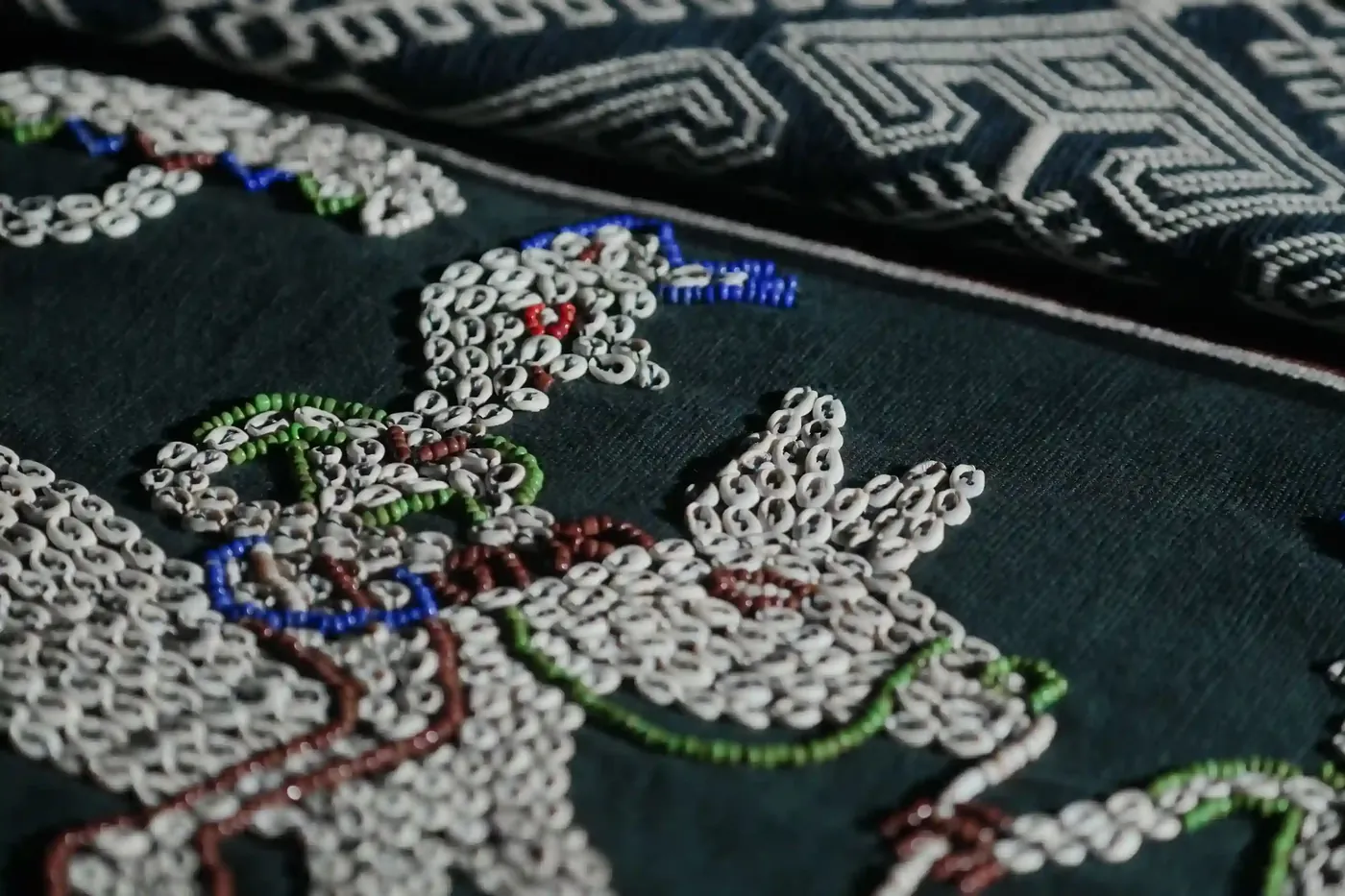
The motifs on Sumbanese traditional cloth are a language of rank, lineage, and the passage between the living and the ancestors rather than decorative pattern, which is why the same horse or skull-tree image carries a different weight on an East Sumba nobleman’s cloth than on a panel woven for the trade. Reading that language changes how a buyer selects, prices, and displays a piece.
What is a hinggi and what is a lau?
The two principal formats of Sumbanese cloth divide by gender of wearer. The hinggi is the large men’s cloth, worn as a pair — one wrapped at the hip, one draped over the shoulder — and woven as two mirror-image panels joined down a centre seam because a backstrap loom cannot produce that width in one piece. The lau is the women’s tubular skirt, and its most prestigious variants are built with supplementary-warp patterning (lau pahikung) or applied beadwork and shell (lau hada) rather than with ikat alone. Almost every symbolic reading you will encounter attaches to one format or the other, so identifying the format is the first step in identifying the meaning.
Why does the design appear on both faces?
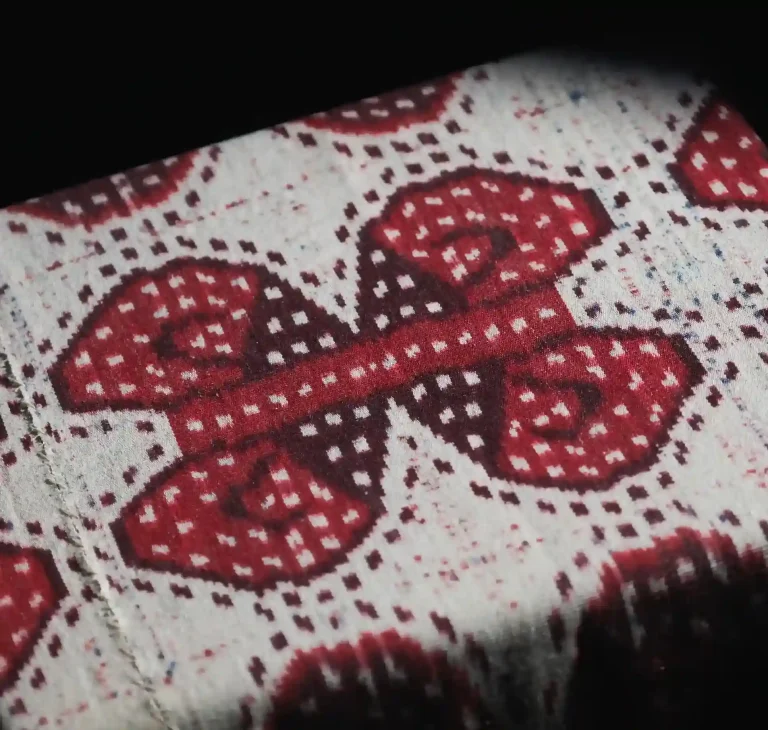
Sumba works in warp ikat, meaning the pattern is bound into the lengthwise threads and dyed before a single weft is thrown. The dye penetrates the tied bundles from both sides, so a genuine piece shows its motifs with comparable clarity front and back, with the characteristically feathered motif edges that arise as the resist ties shift during dyeing. Printed imitation reverses this: crisp on the face, pale and blurred behind. That single test separates a woven cloth from a printed one faster than any label.
The core motif vocabulary
Motif readings vary between clans, villages, and eras, and reputable textile literature presents them as documented interpretations rather than fixed dictionary entries. The table below gives the readings most consistently recorded for East Sumba cloth.
| Motif | Commonly recorded reading | Where it usually appears |
|---|---|---|
| Horse (njara) | Status, wealth, and the mount that carries the dead onward; strongly associated with noble households | Central registers of hinggi |
| Deer | Nobility and the hunt; antler imagery linked to aristocratic prerogative | Paired flanking registers |
| Skull tree (andung) | The pre-colonial display of taken skulls; power, victory, and the authority of the ancestors | Major registers of high-status hinggi |
| Rooster | Announcement and threshold; the passage between night and day, life and death | Border and secondary registers |
| Crocodile, snake, and lizard forms | Ancestral and clan protection; guardianship of the household line | Field and border zones |
| Shrimp and crustaceans | Moulting as renewal; regeneration and continuity after death | Narrow registers and fillers |
| Patola ratu lattice | Derived from Indian patola trade silks; historically restricted to ruling lineages | Centre field of the most prestigious cloth |
What do the colours mean?
Classic East Sumba palettes are built from two natural dye systems and the undyed ground between them: indigo for blue through to near-black, and morinda root for the warm brick red, with the reserved white of the cotton reading as the third colour. Both dyes are built through repeated immersion rather than a single bath, which is why depth of tone historically signalled the resources behind a cloth as clearly as the motifs did. Buyers assembling a sumbanese traditional cloth group for display often find that colour depth, not motif count, is what makes a wall composition read as coherent.
How is a hinggi composed?
A hinggi is organised as a mirrored stack of horizontal registers running out from a centre line, with the two woven panels matched at the seam so that motifs align across it. Reading the cloth means reading that stack: a dominant central band, flanking major registers, narrower secondary bands, and a border, closed at each end by a twined finishing band called kabakil that locks the warp ends. Seam alignment and the quality of that end band are the two construction details experienced buyers check first, because both reveal how much time went into finishing rather than into the visible field.
Cloth in ritual life
In Sumbanese practice textiles function as ritual property, not as clothing alone. Cloth moves in formal exchange between families at marriage and at funerals, is used to wrap and honour the dead, and forms part of the inherited wealth of a house alongside livestock and metal ornaments. This matters commercially for a simple reason: pieces made inside that ritual economy and pieces woven for sale are different objects with different histories, and honest trade names the difference rather than blurring it. Institutions building a documented heritage cloth collection record that distinction in the catalogue entry as a matter of course.
Should buyers worry about displaying certain motifs?
Some imagery carries weight that a decorative context flattens. The skull tree is the clearest case: it references a historical practice and a claim to power, and using it as a casual cushion print reads very differently from presenting it on a wall with a caption that explains what it is. The workable rule for interiors, retail, and exhibition is straightforward — display any motif you like, but label it accurately and never invent a meaning for marketing copy. Where a reading is contested between sources, say so; that honesty is itself a mark of a serious seller.
Frequently asked questions
Do all Sumba motifs have a single fixed meaning?
No. Readings differ between clans, villages, and periods, and the same horse motif can be read as status, as funerary escort, or as both, depending on the household and the cloth’s purpose. Documented textile scholarship records ranges of interpretation rather than one dictionary. A seller who offers a single confident meaning for every motif is usually simplifying for the sale.
How can I tell woven ikat from printed imitation?
Turn the cloth over. Genuine warp ikat is dyed into the threads before weaving, so the motif reads with comparable clarity on both faces and its edges are softly feathered. Printed fabric shows a crisp face and a noticeably paler, blurred reverse. A second check is the end finish: hand-twined warp-end bands take hours of work that printed goods never carry.
What is the patola motif doing on an Indonesian cloth?
Patola were double-ikat silk cloths from Gujarat that entered the eastern Indonesian archipelago through historic maritime trade and were absorbed into local prestige systems. Sumbanese weavers reinterpreted the lattice in cotton warp ikat, and the resulting patola ratu field became associated with ruling lineages. Its presence signals a piece aimed at the top of the traditional hierarchy.
Does motif density affect value?
Yes, because every motif row is tied by hand into the warp before dyeing. A densely patterned field represents weeks of binding work that a plain ground does not, and it also raises the risk of error, since a mistake in the tying is only visible after the dye is set. Density, dye class, and warp fineness together explain most of the price spread between two pieces of identical size.
Ask us about a specific piece
Send photographs of the front, the reverse, the centre seam, and the end bands, and we will talk you through format, motif register, and dye class. Reach our team on WhatsApp at https://wa.me/6281139414563 or email [email protected].
Related
Keep reading
Craft and Culture
Planning a Weaving Village Visit on Sumba Island
A weaving village visit on Sumba works when you treat it as an appointment inside a living community rather than…
Craft and Culture
Indonesian Ikat from Sumba vs Other Regions
Sumba ikat is warp ikat, worked in cotton, and composed as large figurative panels — and almost every difference between…
Craft and Culture
How Sumba Ikat Is Woven: Loom to Finished Cloth
Sumba ikat is made by dyeing the pattern into the yarn before a single row is woven: bundles of warp…