How Sumba Ikat Is Woven: Loom to Finished Cloth
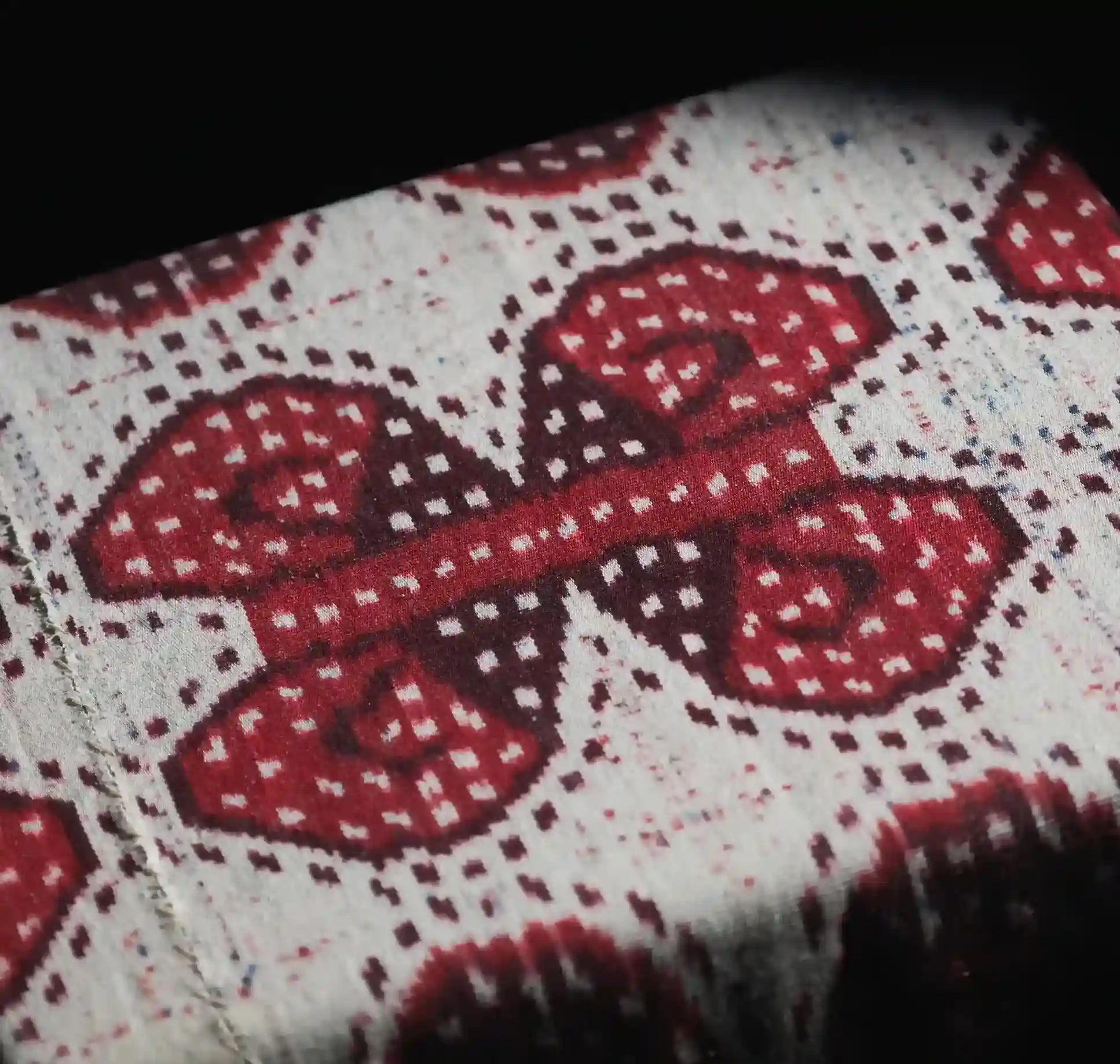
Sumba ikat is made by dyeing the pattern into the yarn before a single row is woven: bundles of warp threads are tied with a water-resistant binding, dipped in dye so the covered sections stay clear, untied, re-tied, and dipped again until the full design exists in thread form — only then is the yarn stretched on the loom and the cloth built. Weaving is the last stage of the process, not the first.
Understanding that sequence explains almost everything buyers find puzzling about handwoven Sumba cloth: why lead times are long, why colours cannot be matched exactly between batches, and why the motif appears on both faces with equal strength.
What happens before any weaving begins?
The technique used in Sumba is warp ikat, which means the pattern lives entirely in the lengthwise threads while the crosswise weft is usually plain. The consequence is that the design must be laid out and fixed in the warp before the loom is ever dressed, with no possibility of correction afterwards.
Preparation starts with cotton yarn, measured out and arranged into a full-length warp on a frame. The weaver — traditionally a woman, working within a village tradition that passes designs between generations — lays out the composition here, deciding motif placement, mirroring, and border structure. A large hinggi is planned as two matching halves later joined along a centre seam, which is why the finished cloth reads as symmetrical about its middle.
How is the pattern tied into the yarn?
Binding is the stage that gives ikat its name and takes the greatest share of the labour. Small bundles of warp threads are tightly wrapped with a material that dye cannot penetrate — historically strips of palm leaf or fibre, and commonly plastic strip today — following the outline of the intended motif.
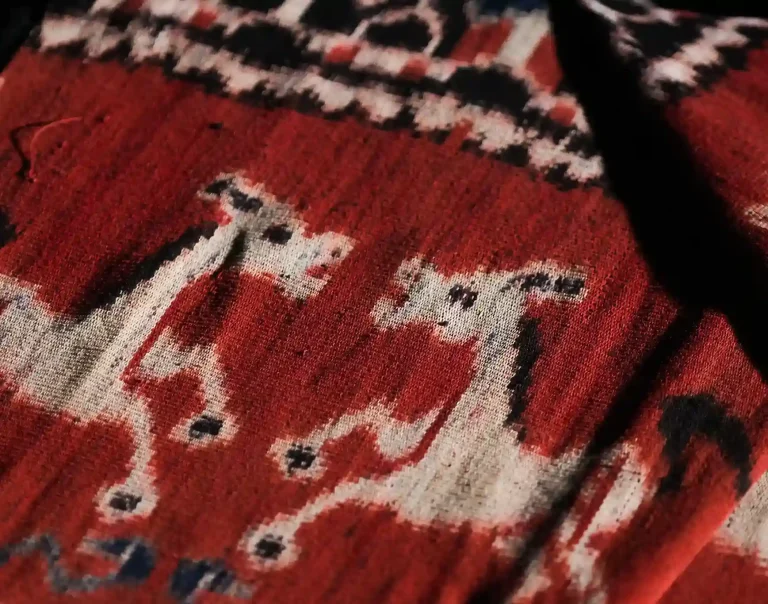
Where the binding sits, the yarn stays its original colour; where it is exposed, the dye takes. Because each colour requires its own round of tying, dyeing, drying, and untying, a multi-colour composition means the same warp is bound and unbound several times. Every tie is placed by eye, which is why motif edges in genuine ikat are softly feathered: a little dye always creeps under the binding. That feathering is the fingerprint of the technique, and the detail printed imitations cannot reproduce.
Which dyes create the colours of Sumba cloth?
Two plant sources define the traditional Sumba palette. Indigo produces the blues, developed through repeated short immersions with oxidation in air between each dip. Morinda root produces the characteristic deep rust reds, and it is the slower of the two — the yarn must first be prepared with an oil-based mordant treatment before the red will hold, and the colour is built through many immersions rather than one.
The darkest tones in a fine piece are usually not a single dye at all but an overdye, with red worked over blue or the reverse, producing near-black and deep aubergine shades. Because each immersion is followed by sun-drying, dyeing depends directly on the weather, and a long wet spell slows an entire production cycle. Natural dye lots also differ from one preparation to the next, which is the technical reason a supplier cannot honestly promise identical colour across repeat orders. Buyers who need matched pieces should keep to a single dye lot, which is how we structure supply for artisanal sumba cloth sourced from named villages.
What happens on the loom?
Once the dyed warp is dry and untied, it is transferred to a backstrap loom — a simple tensioned frame where one end is fixed and the other is held by a strap around the weaver’s body, so tension is controlled by the weaver leaning back. This is why loom width is limited: it cannot exceed a comfortable arm span.
Weaving itself is comparatively quick beside the binding and dyeing, but it demands constant attention. The dyed warp threads must be kept in exact order, since a single thread out of sequence breaks the motif visibly. The weft is passed through and beaten into place row by row, gradually revealing the pattern that has existed in the threads all along. On many hinggi the ends are finished with a twined band worked directly on the loom, a technique known as kabakil, which locks the warp and forms the border before the fringe is released.
How long does one piece take?
There is no single answer, because the time is driven by motif complexity and by how many colour rounds the design requires. What is consistent is the proportion: tying and dyeing dominate, and weaving is the shorter part.
| Stage | What happens | Relative time |
|---|---|---|
| Warp preparation | Yarn measured and laid out; composition planned | Short |
| Binding | Motif tied bundle by bundle, once per colour round | Longest single stage |
| Dyeing and drying | Repeated immersions with sun-drying between | Long, weather-dependent |
| Untying and re-tying | Repeated for each additional colour | Long on complex designs |
| Weaving | Warp dressed on the backstrap loom; weft beaten in | Moderate |
| Finishing | Edge twining, joining of panels, fringe | Short |
A simple two-colour piece may be completed in a matter of weeks. A large, richly figured hinggi in natural dyes runs to many months, and this is why fine pieces cannot be reordered at short notice regardless of budget. Fabric ordered as yardage rather than as finished pieces follows the same sequence, which is why handwoven sumba ikat is quoted with production time stated alongside quantity.
How can you see the process in the finished cloth?
Every stage leaves evidence, and knowing what to look for turns a buyer into a competent inspector. Turn the cloth over first: because the dye is in the thread, the reverse face carries the pattern at nearly full strength, while printed imitation is pale or blank behind.
Then look closely at the motif edges for the soft feathering left by dye creeping under the bindings. Check the repeats along the length — real ikat drifts slightly because each tie was placed by hand, while machine reproduction repeats with mechanical exactness. Feel the surface for small variations in yarn thickness. Finally, look at the ends for a twined finishing band and a hand-released fringe rather than a machine-cut or heat-sealed edge. Five checks, no equipment, and they identify the technique reliably.
Frequently asked questions
Is the pattern dyed before or after weaving?
Before. Bundles of warp threads are bound with a dye-resistant wrapping, dyed, dried, untied, and re-tied for each additional colour, so the complete design exists in the yarn before the loom is dressed. This is what separates ikat from printed or embroidered cloth, and it is why the motif appears on both faces of a genuine piece with almost equal strength.
Why can’t two Sumba ikat pieces be identical?
Every binding is placed by hand against a planned layout, so the resist boundaries differ slightly from bundle to bundle, and natural dye baths vary between preparations. Together these produce small drifts in motif position and colour along the length and between pieces. Buyers needing visual consistency should keep to one dye lot rather than expecting exact matching across separate production runs.
What gives Sumba cloth its red and blue colours?
Indigo produces the blues through repeated short immersions with oxidation in air between dips. Morinda root produces the deep rust reds and requires an oil-based mordant preparation before the colour will hold, built up across many immersions. The darkest near-black tones are usually an overdye of one colour worked over the other rather than a separate dye source.
Why is handwoven Sumba ikat narrow?
It is woven on a backstrap loom, where one end of the warp is fixed and the other is tensioned by a strap around the weaver’s body. Width is therefore limited to what the weaver can comfortably reach across. Large pieces such as the hinggi are woven as two matching panels and joined along a centre seam, which is why the finished cloth reads as symmetrical about its middle.
Source cloth with a traceable process
If you want pieces whose origin, dye composition, and production stage you can verify, tell us the design direction and quantity you have in mind and we will trace it to a named production group. Reach us on WhatsApp at https://wa.me/6281139414563 or by email at [email protected], or read more about our direct textile supplier approach.
Related
Keep reading
Craft and Culture
Sumbanese Traditional Cloth Symbols Explained
The motifs on Sumbanese traditional cloth are a language of rank, lineage, and the passage between the living and the…
Craft and Culture
Planning a Weaving Village Visit on Sumba Island
A weaving village visit on Sumba works when you treat it as an appointment inside a living community rather than…
Craft and Culture
Indonesian Ikat from Sumba vs Other Regions
Sumba ikat is warp ikat, worked in cotton, and composed as large figurative panels — and almost every difference between…