
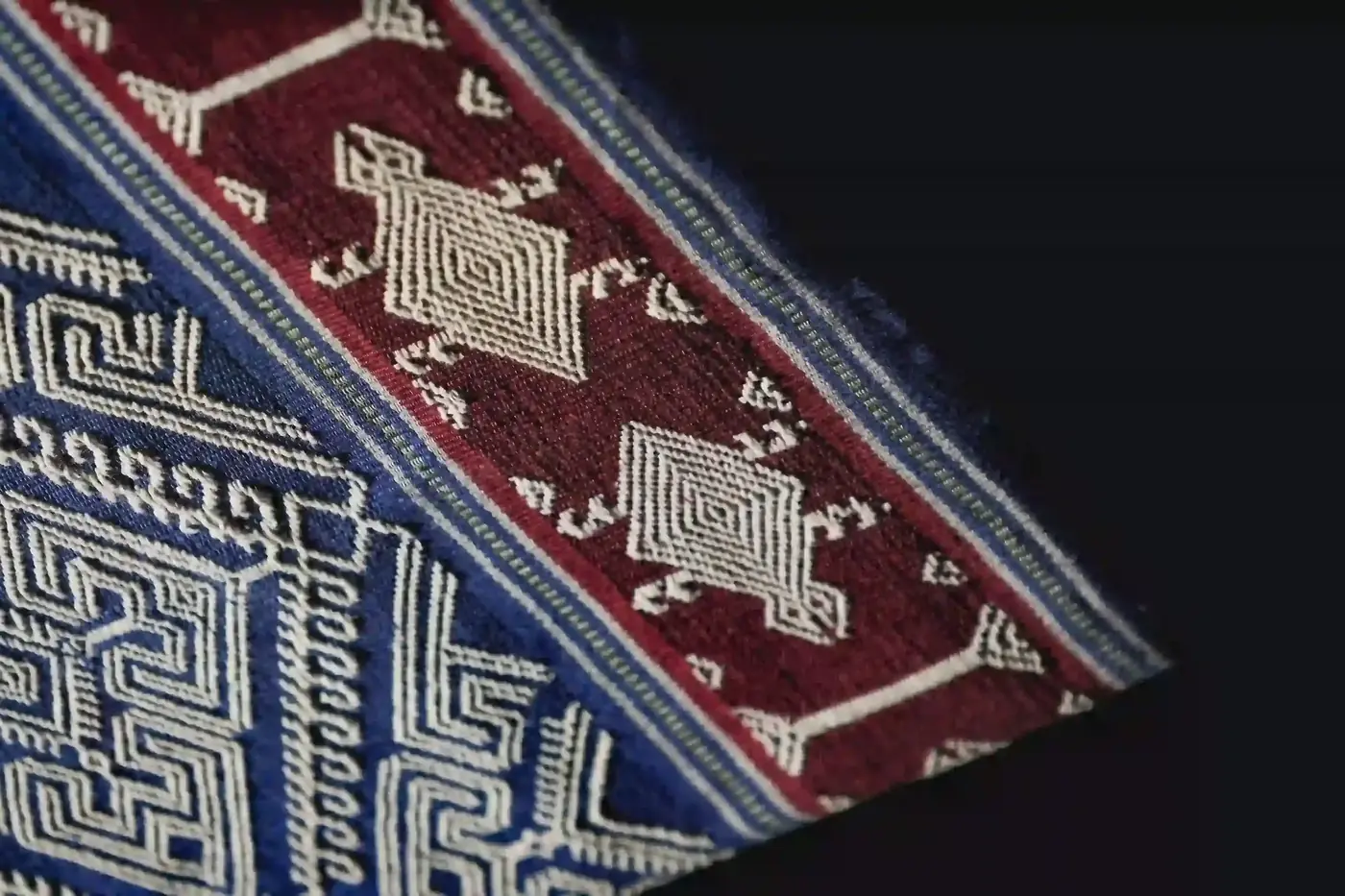
A Sumba ikat table runner works best when it covers about one-third of the table width and either overhangs each end by 15 to 30 centimetres or stops flush with the table edge, with the second decision mattering more than most people expect: overhang suits formal dining, flush suits tables that are used every day.
Handwoven ikat brings one complication to that standard guidance. A backstrap loom produces panels roughly 45 to 70 centimetres wide, which is often wider than the ideal third of a dining table, so a Sumba runner is either hemmed down from a full panel or used deliberately as a broad centre cloth. Knowing that in advance saves a lot of disappointment at the table.
What length and width should you order?
Measure the table first, then decide the overhang, because the runner length is simply table length plus twice the overhang. A 180-centimetre six-seat table with a 20-centimetre drop each end needs a 220-centimetre runner; the same table dressed flush needs 180.
| Table | Table size | Runner length, 20 cm drop | Suggested width |
|---|---|---|---|
| Four seats | 120 x 80 cm | 160 cm | 30 to 40 cm |
| Six seats | 180 x 90 cm | 220 cm | 35 to 45 cm |
| Eight seats | 240 x 100 cm | 280 cm | 40 to 50 cm |
| Ten seats | 300 x 110 cm | 340 cm | 45 to 55 cm |
| Round, six seats | 140 cm diameter | Use a centre cloth, not a runner | 60 to 70 cm square |
| Sideboard or console | 150 x 45 cm | 150 cm, flush | Full panel width |
Why does place setting depth decide the width?
A standard place setting occupies roughly 60 centimetres of table width and about 35 to 40 centimetres of depth from the table edge, which is the real limit on how wide a centre runner can be before plates start sitting on it. On a 90-centimetre table, two settings consume around 70 to 80 centimetres, leaving very little clear centre.
This is why a full-width handwoven panel often works better on a wide table, a console, or a buffet than on a narrow family dining table. If the runner must go on a narrow table, hem it down or accept that it functions as an undercloth beneath the settings rather than a clear decorative strip. Ready-made sizing options are set out on our Sumba ikat table runners page.
Which styling arrangements actually work?
The single centre runner is the default, but it is not always the strongest option, and the alternatives below all use the same cloth in more interesting ways. Each has been used in restaurants and villas because it solves a specific problem.
- Classic centre run: one long runner down the table axis, with candles and low arrangements sitting on it.
- Cross runners: short lengths laid across the table at each setting, turning the runner into a placemat with drop.
- Layered over linen: a plain white or oatmeal cloth beneath, ikat on top, which calms a busy motif and protects the table.
- Off-centre band: runner set deliberately to one side of a wide table, with the arrangement grouped along it.
- Bare-wood run: no undercloth at all, so the ikat sits directly on timber and the two textures work against each other.
- Sideboard dressing: full panel width on a buffet or console, where place settings are not competing for space.
How do you keep a busy ikat motif from overwhelming the table?
Sumba ikat carries dense figurative motifs such as horses, deer, roosters, and the omega-shaped mamuli ornament, and a table dressed with equally busy plates and glassware quickly becomes visually crowded. The reliable rule is that one element in the setting should be doing the talking.
With a patterned runner, use plain white or undyed stoneware, clear glass, and simple flatware. Keep floral arrangements low and monochrome, or replace them with candles and fruit. If the dinnerware is the feature, choose a quieter section of cloth or a piece with wider plain ground between the motif bands. Colour-wise, the brick and rust reds of Morinda-dyed cloth sit comfortably with terracotta, unglazed ceramic, brass, and dark timber; deep indigo works with white, pale grey, and pewter.
Is a Sumba ikat runner practical for daily use?
Handwoven cotton dyed with natural indigo or Morinda root is washable but not indestructible, and its main enemies at a dining table are red wine, oil, and hot dishes placed directly on the cloth. Used with a little care, a runner lasts for years; used as a trivet, it does not.
Practical rules are short. Use mats or boards under hot serving dishes. Blot spills immediately rather than rubbing, since rubbing drives stains into an uneven handweave. Keep candles far enough from the cloth that dripping wax cannot reach it, because wax removal from handspun cotton is difficult. For high-turnover restaurant use, order lined and hemmed runners and rotate several sets so each has time to be laundered and dried properly. Smaller companion pieces such as cushions and napkins are available in our Sumba ikat home textile collection.
How should a runner be washed?
Naturally dyed handwoven cotton should be washed cold, without chlorine bleach, and dried flat in shade rather than direct sun, which is the same guidance conservators apply to keep natural dyes stable over time. Deep indigo may release a little colour in the first wash, so the first launder should be separate.
Hand washing is safest; a delicate machine cycle in a mesh bag is acceptable for lined everyday runners. Do not wring. Press on the reverse with a warm iron and a pressing cloth while the fabric is still slightly damp. Between uses, roll rather than fold if the piece is valuable, since repeated folding on the same line eventually breaks the fibres there.
Frequently Asked Questions
What size runner do I need for a six-seat dining table?
For a table around 180 by 90 centimetres, order a runner of about 220 centimetres if you want a 20-centimetre drop at each end, or 180 centimetres to finish flush with the edge. Width of 35 to 45 centimetres keeps the cloth clear of place settings, which occupy roughly 35 to 40 centimetres of depth from each side of the table.
Can I use a Sumba ikat runner on a round table?
A long runner does not suit a round table because it leaves two large empty arcs. Use a square or circular centre cloth instead, sized at roughly half the table diameter, so a 140-centimetre round table takes a centre piece of about 65 to 70 centimetres. That size sits comfortably within a handwoven panel width without needing a seam.
Are these runners suitable for restaurant service?
Yes, with the right specification and enough sets in rotation. Order runners lined and hemmed rather than raw-edged, since unfinished handwoven cotton frays quickly under service handling. Plan on at least three sets per table so laundered pieces can dry flat in shade rather than being tumble dried, which is what shortens the life of natural dyes fastest in a commercial setting.
Will the colour fade on a table near a window?
Sustained direct sunlight fades natural dyes, and a table beside an unshaded window is one of the harsher environments in a home. Indigo and Morinda red both lose depth under prolonged ultraviolet exposure. If the table cannot be moved, keep the runner off it between meals, rotate two runners so neither takes the full exposure, or choose a synthetically dyed piece for that specific position.
Order runners in your table size
Send us your table dimensions, how many sets you need, and whether the runners are for a home or for service, and we will confirm the achievable width, length, and finishing. WhatsApp https://wa.me/6281139414563 or email [email protected]. Restaurants should tell us their laundry process so we can specify the right lining.
Related
Keep reading
Interiors
Using Ethnic Home Textiles in Modern Interior Design
An ethnic home textile works in a modern interior when it is treated as the single loudest object in the…
Interiors
Sumba Ikat for Hotel and Villa Decor Projects
Sumba ikat belongs in a hotel or villa project as a specified decorative element with its own procurement track, not…
Interiors
Designing Fashion with Sumba Ikat Fabric
Designing with Sumba ikat means designing around the cloth rather than imposing a pattern onto it: the motif is dyed…