
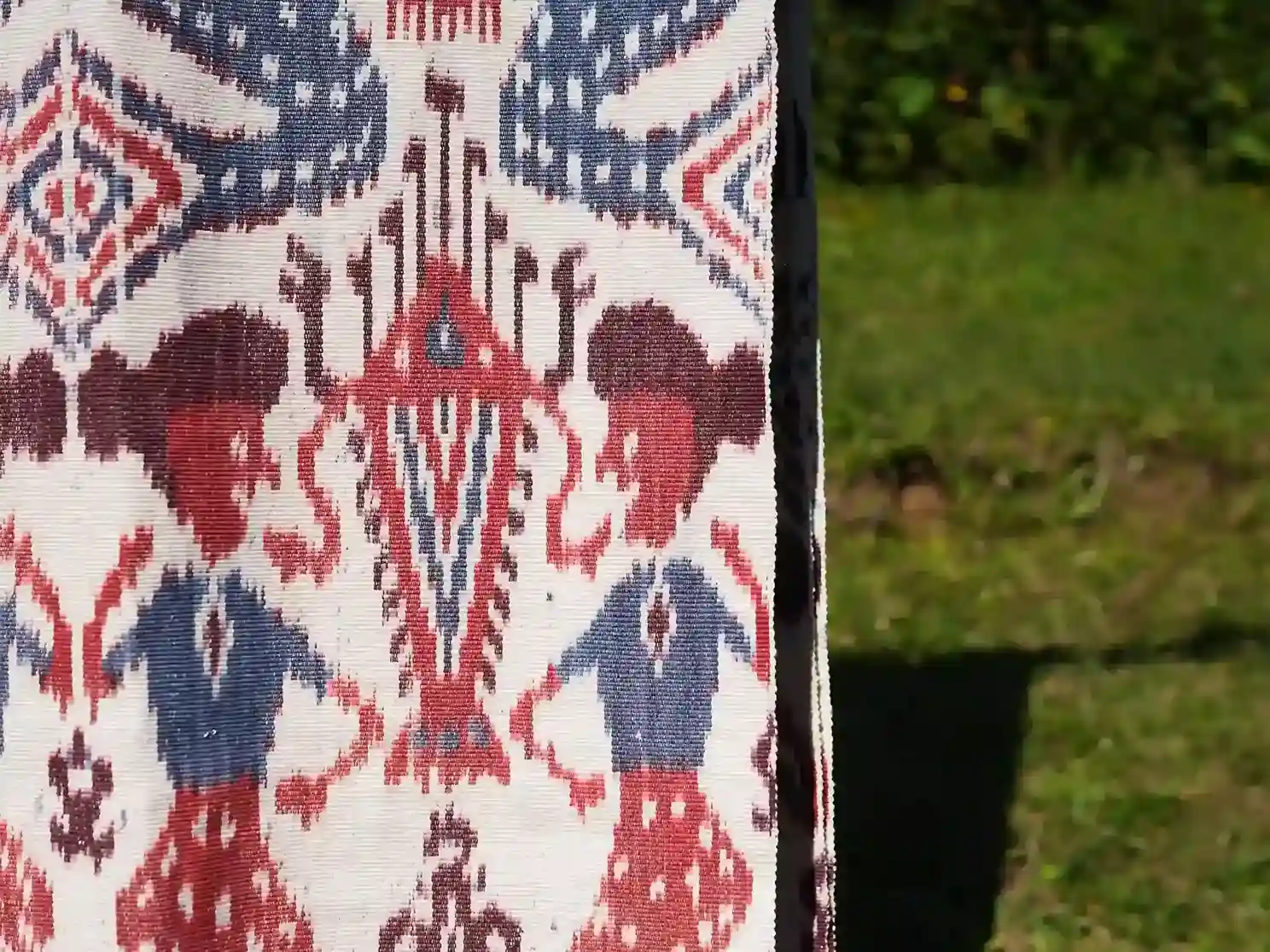
Sumba ikat belongs in a hotel or villa project as a specified decorative element with its own procurement track, not as a late-stage styling purchase, because each piece is handwoven over weeks and cannot be reordered at short notice. Projects that place ikat in the specification package alongside joinery and lighting get the pieces they designed around; projects that leave it to the final fit-out week end up substituting.
What follows is a working method for designers, purchasing managers, and villa owners integrating Sumba handwoven cloth into hospitality interiors — where it performs well, how to schedule it, and how to protect it once installed.
Where does Sumba ikat work best in a hospitality interior?
The classic large-format Sumba textile is the hinggi, a rectangular mantle woven in mirrored halves and traditionally worn by men in East Sumba. Its proportions — long, symmetrical, with a strong central axis — happen to suit exactly the wall planes that hotel interiors struggle to fill: the panel behind a bed, the end wall of a corridor, the flat face above a reception desk.
| Location | Suggested format | Practical note |
|---|---|---|
| Guest room feature wall | Large hinggi, framed or slat-mounted | Mirrored composition centres naturally above a bed |
| Lobby and reception | Statement panel or grouped set | Keep pieces from one dye lot for visual coherence |
| Restaurant tables | Runners and placements | Specify washable secondary cloth for direct food contact |
| Corridors and stairwells | Vertical narrow panels | Low light exposure extends colour life considerably |
| Villa living areas | Cushions, throws, upholstery accents | Use as accent rather than high-traffic seating surface |
| Spa and quiet rooms | Single muted piece | Indigo-dominant pieces read calmer than red-dominant ones |
For project-scale specification across several room types at once, our ethnic decor textile programme is built around room-type schedules rather than individual pieces.
How should a project schedule handle handwoven lead times?
In ikat, the pattern is tied and dyed into the yarn before a single row is woven, so the design is committed long before the cloth exists. That production sequence makes late design changes expensive in time rather than money, and it is the reason ikat must enter the programme early.
Work backwards from installation. Reserve time for design selection and sampling, for yarn preparation and dyeing, for weaving, for finishing and mounting, and for freight and customs clearance at the destination. Then add contingency, because dyeing depends on sun-drying between baths and a long wet spell genuinely slows production. The practical rule is to lock ikat selection at the same milestone as tile and stone, not at the same milestone as loose furnishings.
For phased hotel openings, order the full quantity in one production block even when installation is staged. Splitting a hundred-room order across two production windows almost guarantees a visible colour step between floors.
What about durability, cleaning, and light exposure?
Natural dyes in Sumba cloth — indigo for blue, morinda root for the characteristic deep reds — are light-sensitive, and direct tropical sunlight will shift them over time. This is the single biggest factor in how a piece looks after two years, and it is entirely controllable at the specification stage.
- Position framed pieces away from direct sun; where that is impossible, specify UV-filtering glazing.
- Keep pieces off exterior-facing walls in humid climates, where condensation encourages mould.
- Brief housekeeping in writing: dry dusting or low-suction vacuuming through a screen, never a wet wipe.
- Route any cleaning beyond dusting to a textile conservator or specialist cleaner, not to the standard laundry.
- For dining use, treat ikat runners as decorative and place a washable underlayer beneath plated food.
- Confirm flame-retardance requirements with your local authority and use a specialist treatment provider — never assume an untreated handwoven cloth meets a commercial standard.
How do you handle motif meaning respectfully?
Sumba motifs carry meaning. Horses, roosters, and the andung or skull-tree motif of East Sumba are not decorative abstractions; several are historically tied to status, ancestry, and ceremony. Some cloth types were made for ritual and funerary use rather than for display.
The workable approach for a commercial interior is simple. Ask what a motif means before specifying it, prefer pieces woven for the market over pieces with a ceremonial provenance, and credit the origin in your guest-facing material — a short caption naming Sumba and the weaving tradition. Avoid cropping a composition in a way that severs a motif, and avoid using a ceremonial piece as a floor covering or a seat. Guests increasingly ask where things come from, and an interior that answers that question well earns more from the textile than one that treats it as pattern.
What should the specification package contain?
Because handwoven pieces vary within an agreed band, a project specification has to describe a range rather than a fixed object. Include design family and motif region, finished dimensions with tolerance, yarn and dye type, mounting method and hardware, lot-grouping instructions by room type, and the housekeeping care note that will be handed to the operations team.
Add one clause that is often missed: an attic stock allowance. Order a small surplus in the same production block so that a damaged or stained piece can be replaced from matching stock years later, when the original dye lot no longer exists. For high-visibility statement locations, buyers working with premium ikat cloth should agree the attic quantity at quotation stage rather than after handover.
Frequently asked questions
Can Sumba ikat be used as upholstery in a hotel?
It can, with limits. Handwoven ikat is not engineered for the abrasion levels of primary seating in a busy public area, so it performs best as an accent — a cushion, a chair back, a bench inlay — rather than as the main wearing surface. Where heavier use is unavoidable, back the cloth and confirm abrasion and flame requirements with your local authority before specifying.
How far in advance should ikat be ordered for a hotel opening?
Lock the selection at the same programme milestone as tile and stone, not with loose furnishings. Yarn is tied, dyed, sun-dried, and only then woven, so a design change after production starts resets the sequence. Order the whole quantity in a single production block even when installation is phased, otherwise a visible colour step can appear between floors or wings.
Will the colours fade in a tropical villa?
Natural indigo and morinda dyes shift under strong ultraviolet light, so placement matters more than any treatment. Pieces hung away from direct sun in ventilated interiors hold their colour well for years, while a piece facing an unshaded window will change noticeably. Specify UV-filtering glazing for framed work in bright rooms and keep textiles off exterior-facing walls in humid conditions.
Can we order matching pieces for every room in a property?
Matching within a dye lot is achievable; matching across lots produced months apart is not, because natural dye batches differ. The practical answer is to produce the full property quantity in one block and to group pieces by lot per floor or wing. Build in an attic stock allowance at the same time so later replacements still sit correctly beside the originals.
Specify Sumba ikat for your project
Share your room schedule, wall dimensions, and installation dates and we will map a production block, lot-grouping plan, and attic stock allowance around them. Contact us on WhatsApp at https://wa.me/6281139414563 or email [email protected].
Related
Keep reading
Interiors
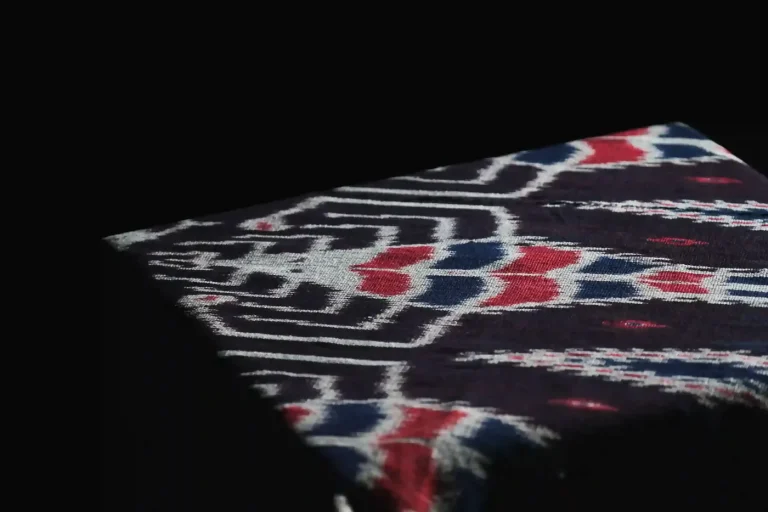
Using Ethnic Home Textiles in Modern Interior Design
An ethnic home textile works in a modern interior when it is treated as the single loudest object in the…
Interiors
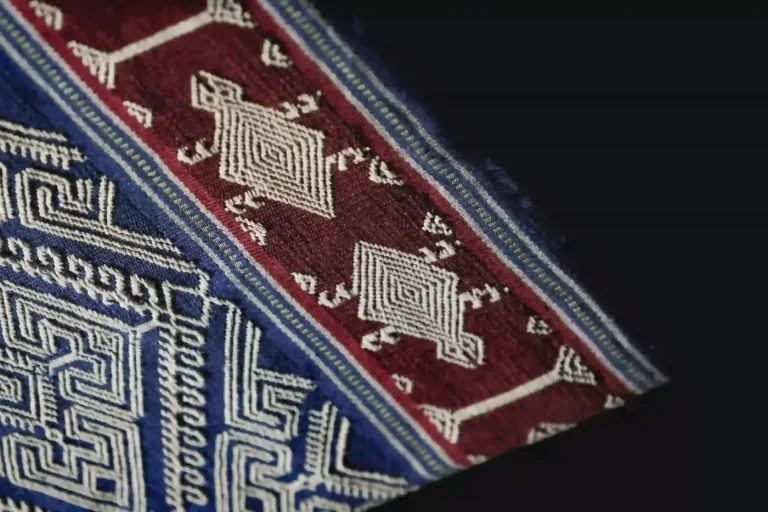
Sumba Ikat Table Runner Ideas for Dining Rooms
A Sumba ikat table runner works best when it covers about one-third of the table width and either overhangs each…
Interiors
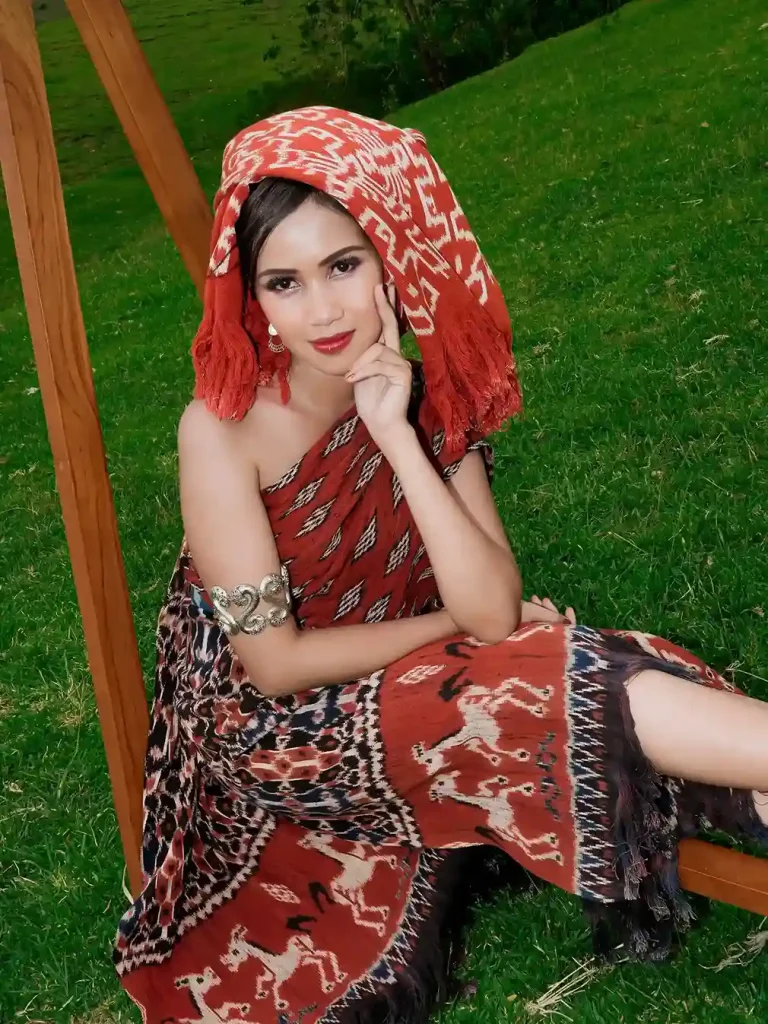
Designing Fashion with Sumba Ikat Fabric
Designing with Sumba ikat means designing around the cloth rather than imposing a pattern onto it: the motif is dyed…