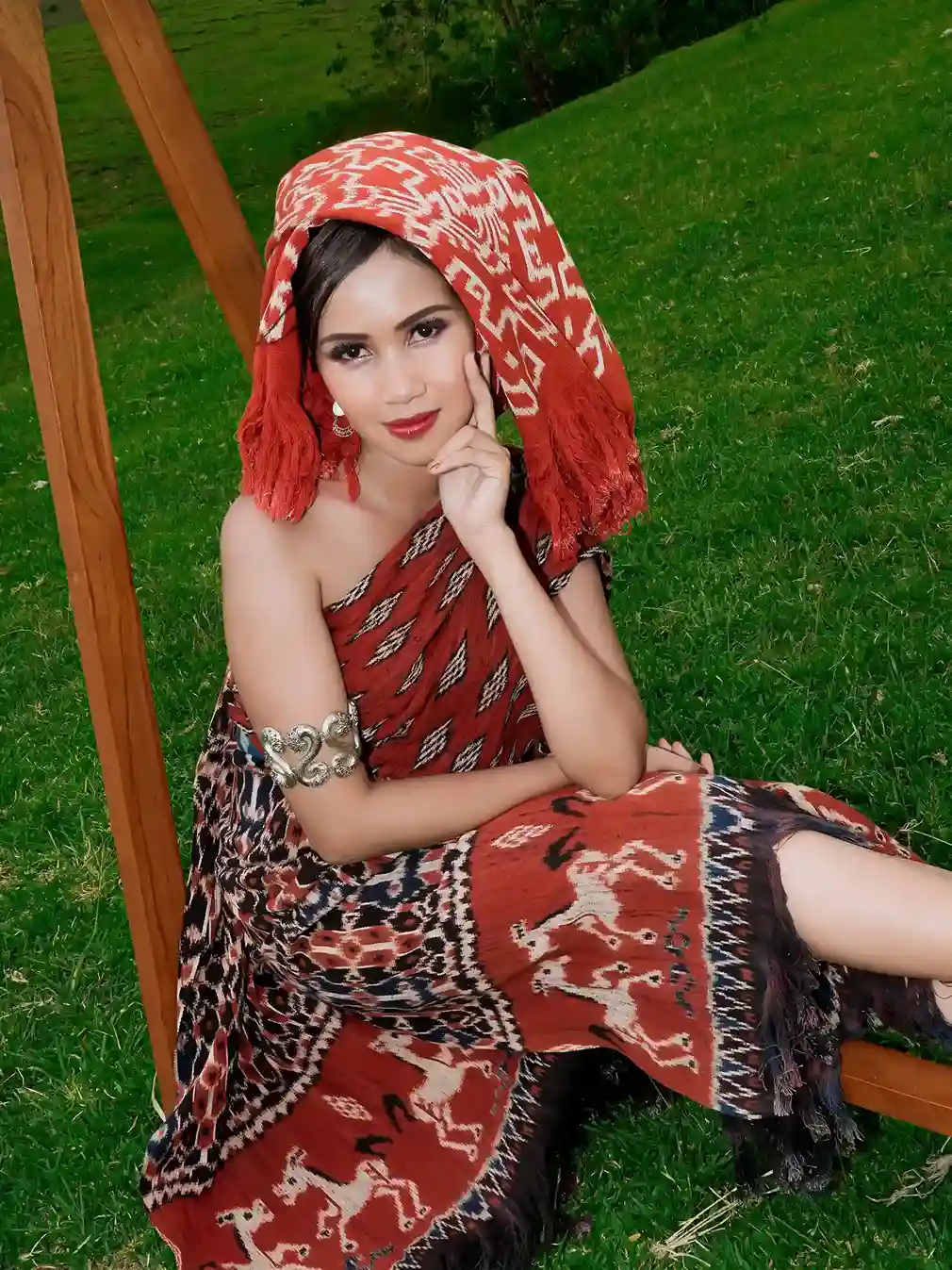
Designing with Sumba ikat means designing around the cloth rather than imposing a pattern onto it: the motif is dyed into the yarn before weaving, so it cannot be repositioned, rescaled, or repeated at the cutting table the way a printed fabric can. Every successful ikat garment starts from a placement plan drawn on the actual piece of cloth, not from a standard marker layout.
This guide is for fashion designers, accessory makers, and small production studios working with handwoven Sumba cloth for the first time, and covers what the material demands at the pattern, cutting, and finishing stages.
What should a designer know about the cloth before cutting?
Sumba ikat is woven on a backstrap loom, which sets the usable width far narrower than industrial fabric — traditional pieces are frequently woven as two panels and joined along a centre seam. That single constraint reshapes the pattern block: wide one-piece bodies, full-circle skirts, and long uncut drapes usually cannot be cut from a single width.
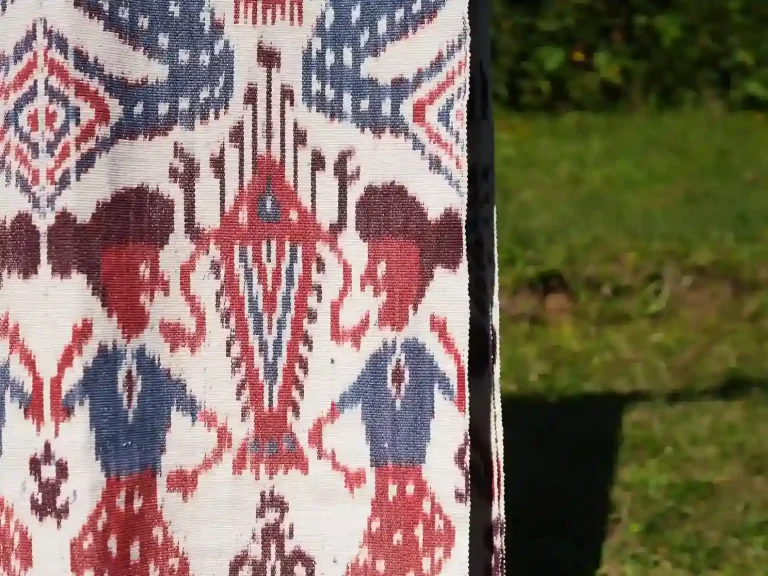
Two more properties matter before the shears come out. The pattern runs in the warp direction, so orientation is fixed by the weave and cannot be rotated without turning the motif sideways. And the feathered edge that identifies real ikat comes from dye bleeding into tied yarn, which means motif boundaries are soft — precision seaming through the middle of a motif reads as an error rather than as a detail. Designers buying yardage should confirm loom width and panel structure before finalising the block; both are stated when you buy ikat fabric by the metre rather than as finished pieces.
How do you plan pattern placement?
Because the motif exists only once and in one position, placement is a design decision made per piece. Lay the cloth flat, photograph it, and mark the pattern pieces on the photograph before touching the fabric. This costs an hour and saves the cloth.
- Identify the dominant motif and decide where it should sit on the body — centre front, one shoulder, a hem band.
- Keep the strongest motif away from bust darts, pocket openings, and closure lines that will interrupt it.
- Where a piece is woven in mirrored halves, use the axis of symmetry deliberately: centred on a back panel it reads as intentional, offset by a few centimetres it reads as a mistake.
- Plan seams to fall in quiet ground areas between motifs rather than through them.
- Accept that matching across a seam is approximate; aim for continuity of rhythm, not exact registration.
- Cut the highest-visibility pieces first, then fit smaller components into what remains.
Which garment and accessory types suit ikat best?
Handwoven cotton ikat is a stable, medium-weight cloth with almost no stretch and a visible surface texture, which favours structured and rectilinear shapes over fluid draping.
| Application | Fit with ikat | Design note |
|---|---|---|
| Unstructured jackets and haori shapes | Strong | Flat panels showcase a full motif without cutting through it |
| Straight and wrap skirts | Strong | Panel width suits the narrow loom naturally |
| Bags, clutches, and pouches | Strong | Small cuts use offcuts and place one motif well |
| Waistcoats and vests | Good | Symmetry can be split cleanly along the front opening |
| Trims, cuffs, and collar facings | Good | An economical way to introduce ikat into a wider collection |
| Bias-cut dresses and fluid drapes | Weak | Bias distorts the feathered motif and stresses the weave |
| Close-fitting stretch garments | Weak | The cloth has no recovery and will bag at stress points |
How should ikat be cut and stabilised?
Handwoven cotton frays readily along cut edges because the yarns are not locked by any finishing process. Every raw edge therefore needs immediate treatment — overlocking, binding, a French seam, or a stay-stitch line placed before the piece leaves the cutting table.
Cut on the straight grain wherever possible, single-ply rather than folded, with the cloth fully relaxed and not pulled taut. Handwoven cloth has small variations in density across its width, and stretching during cutting bakes distortion into the finished garment. Use pattern weights instead of pins in motif areas, and keep the warp direction consistent across all pieces so the surface catches light uniformly.
Test any pressing on an offcut first. Natural-dyed cotton generally takes a warm iron with a pressing cloth, but high heat directly on the surface can flatten the texture that gives the cloth its character.
What about lining, interfacing, and finishing?
Ikat looks best when the reverse face is treated as part of the design, since a genuinely dyed-through pattern is nearly as strong on the back as on the front. That opens options a printed fabric never offers: unlined jackets with bound seams, reversible wraps, and facings that reveal the underside intentionally.
Where lining is needed for comfort or structure, choose a natural fibre lining of similar weight so the two layers respond alike to humidity — a synthetic lining against handwoven cotton often creates bubbling after a season. Keep fusible interfacing to a minimum and prefer sew-in interfacing at collars and closures, because fusing can flatten the surface texture and is difficult to reverse. Finish with hardware that suits the material’s weight rather than its price: heavy metal fittings on a fine handwoven panel will eventually tear at the fixing point. Designers producing a run rather than one-off pieces should confirm consistent panel widths before cutting, which is why sumba ikat fabric for fashion is quoted with the loom structure stated in advance.
How should care instructions be written for the customer?
Natural dyes can release a little colour in early washes, and handwoven cotton relaxes and shifts slightly when wet. Both are normal properties of the material, but a customer who has not been told will read them as a defect.
Write the care label around three points: cold hand wash separately or professional dry clean, dry in shade rather than direct sun, and press on the reverse with a cloth. Add one line explaining that slight colour variation and small irregularities are evidence of hand weaving. That sentence converts the most common complaint into the reason for the purchase.
Frequently asked questions
Can Sumba ikat be cut on the bias?
It is generally a poor choice. The feathered motif edge that identifies genuine ikat is aligned to the warp, and cutting across it at forty-five degrees distorts the pattern while stressing a cloth that has no stretch recovery. Handwoven cotton also frays heavily on bias edges. Straight-grain cutting with panel seams gives a better result and respects the loom structure.
How wide is handwoven Sumba ikat fabric?
Considerably narrower than industrial fabric, because it is woven on a backstrap loom, and traditional large pieces are often two panels joined at a centre seam. Confirm the actual width and panel structure before finalising your pattern block, since wide one-piece bodies and full-circle shapes usually cannot be cut from a single width without a join.
Should ikat fabric be pre-washed before cutting?
Test on an offcut rather than committing the whole length. Natural-dyed cotton may release a little colour and will relax slightly when wet, so a pre-wash can be useful for garments intended to be washed later. For structured or lined pieces that will be dry cleaned, cutting the cloth as supplied usually preserves the surface texture better.
How do you match a motif across a seam?
Aim for continuity of rhythm rather than exact registration. Because the pattern is dyed into the yarn by hand, repeats drift slightly along the length and cannot be aligned with print-like precision. Place seams in the quiet ground between motifs, keep the strongest motif whole on a single panel, and let the small irregularities read as part of the material.
Source ikat for your collection
Send us your garment type, quantity, and palette direction and we will advise on panel width, motif placement, and the yardage your block actually needs. Reach us on WhatsApp at https://wa.me/6281139414563 or email [email protected].
Related
Keep reading
Interiors
Using Ethnic Home Textiles in Modern Interior Design
An ethnic home textile works in a modern interior when it is treated as the single loudest object in the…
Interiors
Sumba Ikat Table Runner Ideas for Dining Rooms
A Sumba ikat table runner works best when it covers about one-third of the table width and either overhangs each…
Interiors
Sumba Ikat for Hotel and Villa Decor Projects
Sumba ikat belongs in a hotel or villa project as a specified decorative element with its own procurement track, not…