
Indonesian Ikat from Sumba vs Other Regions
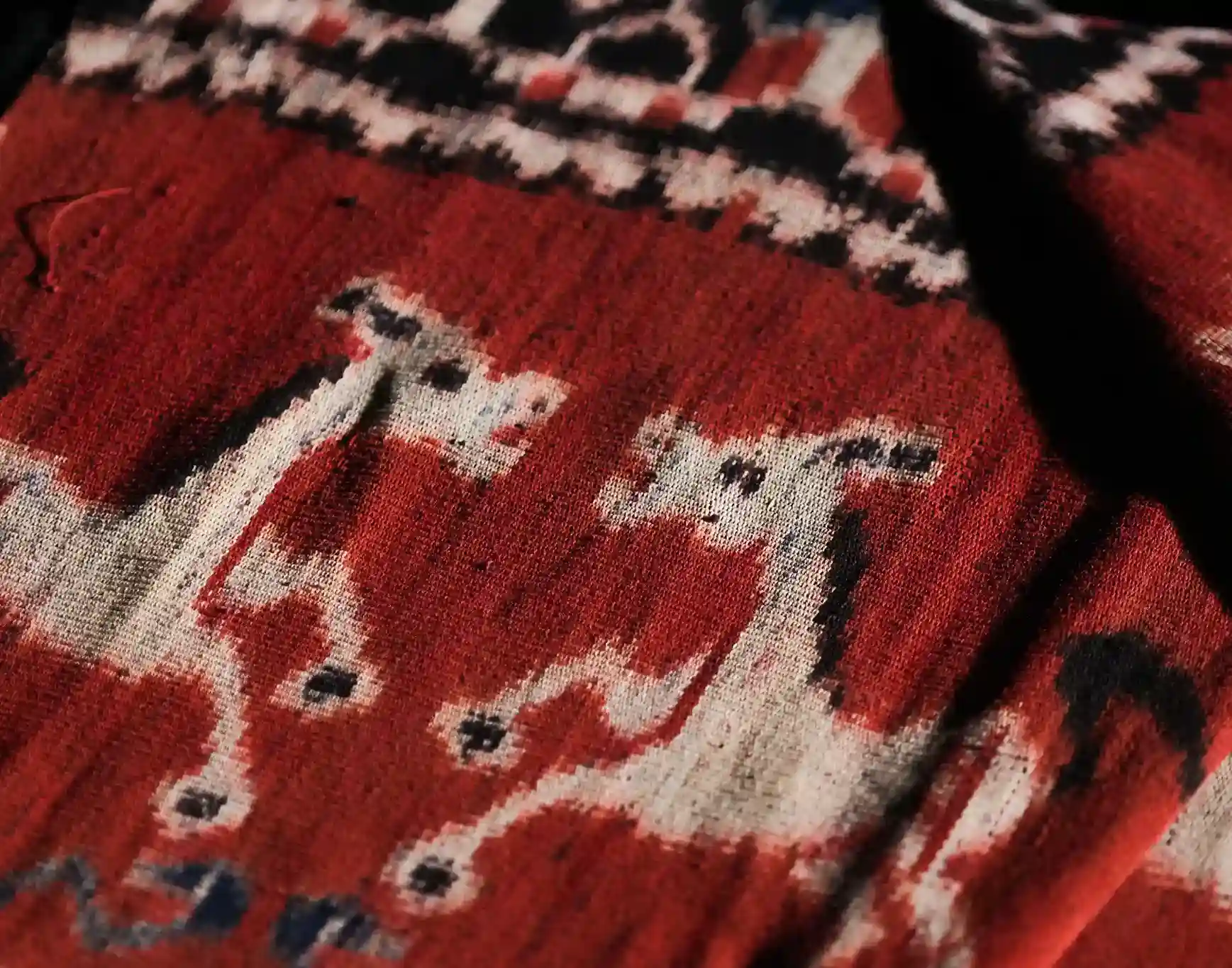
Sumba ikat is warp ikat, worked in cotton, and composed as large figurative panels — and almost every difference between Sumba and the other Indonesian ikat traditions can be traced to one of those three axes: which thread system carries the resist, which fibre is used, and whether the design is pictorial or geometric. Once a buyer can place a cloth on those three axes, identifying its region becomes far easier than memorising motif catalogues.
What is the difference between warp, weft, and double ikat?
In warp ikat the lengthwise threads are bound and dyed before weaving, and the weft is usually a plain colour, so the pattern already exists on the loom before a single row is woven. In weft ikat the crosswise threads carry the pattern, which the weaver must align row by row as the cloth grows. In double ikat both systems are resist-dyed and must meet exactly where they cross — a technique found in only a handful of places worldwide, including the geringsing of Tenganan in Bali. Sumba works in warp ikat, which is why its motifs show that characteristic feathered edge running along the length of the cloth.
How do the main Indonesian ikat regions compare?
The table below sets out the working distinctions a trade buyer needs rather than an exhaustive ethnographic map. Traditions overlap and modern workshops cross the boundaries, so treat it as an orientation, not a rulebook.
| Region | Technique | Typical fibre | Design character |
|---|---|---|---|
| Sumba (East Nusa Tenggara) | Warp ikat | Cotton | Large figurative registers: horses, deer, skull trees, patola-derived lattices |
| Flores and the Solor–Lembata chain | Warp ikat | Cotton | Narrow panel sarongs, dense geometric and stylised bands, strong regional sub-styles |
| Timor | Warp ikat, often with supplementary techniques | Cotton | Banded compositions, frequently combined with non-ikat patterned strips |
| Savu and Rote | Warp ikat | Cotton | Ordered bands of repeating motifs, with pattern groups tied to lineage identity |
| Bali (Tenganan) | Double ikat | Cotton, historically with imported yarn | Rare ritual cloth; restrained palette, geometric and figural rosettes |
| Bali (endek) | Weft ikat | Silk, rayon, blends | Fluid florals and geometrics, dressier hand, contemporary colourways |
| Java (Troso and similar centres) | Weft ikat | Cotton, rayon, blends | Commercial yardage, wide colour range, high repeatability |
| Sulawesi | Warp ikat inland; weft ikat silk on the coast | Cotton or silk | Large geometric warp-ikat panels; lustrous silk weft-ikat cloth in trading centres |
Which one should a buyer choose?
Match the tradition to the job rather than to the story. Sumba’s figurative warp ikat is unmatched for statement wall pieces, gallery presentation, and interiors that need one commanding textile, because the format was designed to be read whole. Balinese endek and Javanese weft ikat suit apparel and repeat-order yardage, where drape and colour consistency matter more than narrative motifs. Flores and Timor panels excel where a buyer wants dense pattern in a narrower format. Buyers assembling a mixed range often anchor the collection with Sumba and fill the commercial tiers elsewhere; our indonesian ikat fabric selection is built around that anchoring role, and volume programmes run through handwoven textile wholesale terms.
How do the commercial realities differ?
Technique dictates lead time. Warp ikat front-loads the labour into binding and dyeing before weaving even begins, so a natural-dye Sumba piece has a long, largely fixed production window that cannot be compressed by adding weavers. Weft-ikat workshops in Bali and Java, working with commercial yarn and synthetic dye, can hold stock and reorder in a fraction of that time. Double ikat sits in a category of its own, produced in tiny quantities and effectively unavailable as trade volume. A range plan that assumes uniform lead times across these traditions will miss its dates on the Sumba lines first.
Can you identify the region by looking at the cloth?
Three quick checks resolve most cases. First, look at the direction of the feathered blur: if it runs lengthwise along the cloth it is warp ikat, which points to Sumba, Flores, Timor, Savu, or inland Sulawesi; if it runs across the width, weft ikat, pointing to Bali, Java, or the silk-weaving coastal centres. Second, feel the fibre — the crisp, matte hand of hand-spun or plied cotton reads very differently from the slip of silk or rayon. Third, read the format: a large cloth built as two mirrored panels joined at a centre seam, with horses or deer in the major registers, is Sumbanese by construction, not just by motif.
Is one region’s ikat better than another’s?
No, and framing it that way misleads buyers. The traditions solve different problems: Sumba produces ceremonial cloth intended to be seen at full size and carry meaning; Bali and Java produce cloth intended to be worn, cut, and reordered. The genuine quality axis inside any of them is the same — natural versus synthetic dye, hand-tied versus stencilled or printed pattern, fineness of yarn, and finishing. A finely made Flores panel outranks a coarse Sumba piece, and vice versa. Judge the cloth, not the postcode.
Frequently asked questions
Is all Indonesian ikat handwoven?
No. The word ikat describes a resist-dye process, and today it also gets applied loosely to printed fabrics that merely imitate the look. Genuine ikat, whether warp or weft, shows the pattern dyed into the yarn, so it reads on both faces with softly blurred motif edges. Printed imitation is crisp on the face and pale on the reverse. Ask explicitly whether a piece is woven or printed.
Why is Sumba ikat usually more expensive than Javanese weft ikat?
Because the labour profile is different. Sumba’s classic pieces are hand-tied over long periods and, at the top tiers, dyed with morinda and indigo through repeated immersions that take months. Javanese and Balinese weft-ikat workshops typically use commercial yarn and synthetic dye with far shorter cycles. The price gap reflects production time and dye class rather than any judgement of craftsmanship.
What exactly makes geringsing double ikat so rare?
In double ikat both the warp and the weft are resist-dyed separately and then must register against each other on the loom, so any drift in either system shows as a misaligned pattern. It is produced in very small quantities in Tenganan, Bali, and is effectively unavailable as commercial volume. Buyers should treat any large stock offer of double ikat with scepticism.
Can I mix ikat from several regions in one collection?
Yes, and it works well when the pieces are labelled honestly by origin and technique. A common approach anchors a room or a range with one large Sumba warp-ikat panel and supports it with narrower Flores or Timor bands and Balinese weft ikat for soft goods. Problems arise only when mixed origins are marketed under a single regional name.
Talk to us about a mixed sourcing plan
Tell us which formats and price tiers your range needs and we will map which Sumba lines anchor it and where other traditions fit. Message us on WhatsApp at https://wa.me/6281139414563 or email [email protected].
Related
Keep reading
Craft and Culture
Sumbanese Traditional Cloth Symbols Explained
The motifs on Sumbanese traditional cloth are a language of rank, lineage, and the passage between the living and the…
Craft and Culture
Planning a Weaving Village Visit on Sumba Island
A weaving village visit on Sumba works when you treat it as an appointment inside a living community rather than…
Craft and Culture
How Sumba Ikat Is Woven: Loom to Finished Cloth
Sumba ikat is made by dyeing the pattern into the yarn before a single row is woven: bundles of warp…