
How to Spot Authentic Sumba Ikat Before You Buy
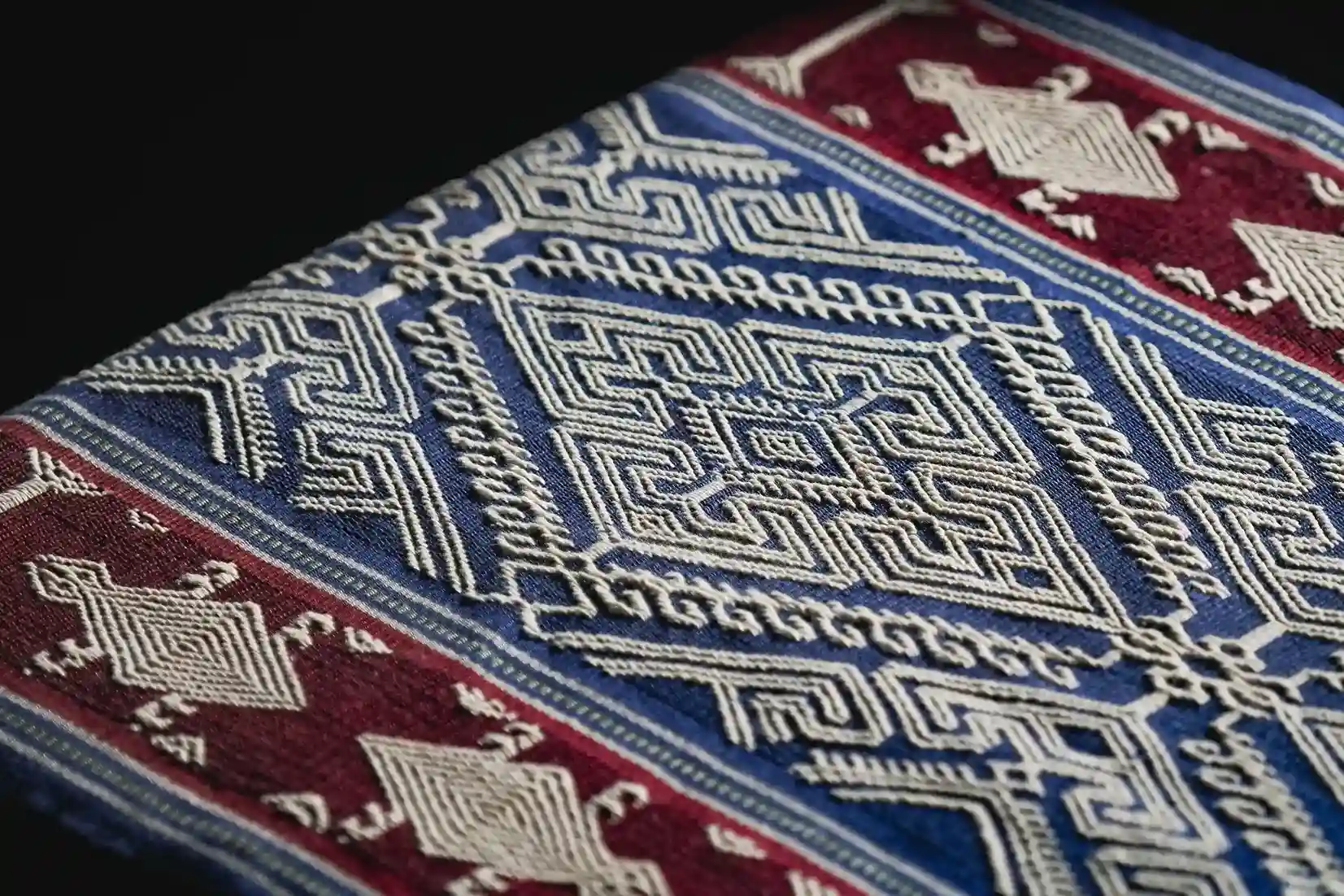
You can identify an authentic Sumba ikat textile by four checks that take under a minute: the pattern edges are softly feathered along the length of the cloth and crisp across it, the design is as strong on the reverse as on the face, the yarn shows uneven handspun thickness against the light, and the side edges are woven selvedges rather than cut or serged.
Those four checks catch almost every printed imitation, and they work in a shop, at a stall, or on a photograph if the seller sends close-ups. The reason they work is structural. Warp ikat is made by binding and dyeing the lengthwise threads before weaving begins, so the finished cloth carries physical evidence of that process that no printing method reproduces.
Why does genuine ikat have blurred pattern edges?
During weaving, the resist-dyed warp threads shift very slightly against each other as the weft is beaten in, which softens every pattern boundary running across the cloth. That feathering is the signature of the technique, not a flaw, and skilled weavers control how much of it appears rather than eliminating it.
Look at the direction of the blur. In warp ikat from Sumba, edges perpendicular to the length are feathered while edges running along the length stay comparatively sharp, because the threads only shift sideways. A print blurs equally in every direction or not at all. If a pattern looks uniformly razor-sharp on all four sides of every motif, you are almost certainly looking at a printed cloth.
What does the reverse side tell you?
Because the dye penetrates the thread itself before weaving, an authentic piece shows the pattern at close to full strength on the back, and turning a cloth over is the single fastest test available. A screen-printed or digitally printed cloth carries colour only on the surface, so its reverse is noticeably paler, patchy, or plain.
Two cautions apply. A supplementary-weft or embroidered piece will legitimately look different on the back, so check you are testing an ikat rather than another technique. And a heavy print can push some colour through a loose weave, so pair this check with the feathering check.
How do you read the yarn and the weave?
Handspun cotton has visibly uneven thickness, with thin sections and slubs along the same thread, and holding the cloth up to a window makes this obvious in seconds. Machine-spun yarn is uniform along its whole length, which is not itself proof of a fake but tells you which product tier you are in.
| What you check | Handwoven Sumba ikat | Printed imitation |
|---|---|---|
| Pattern edges | Feathered across the cloth, sharper along it | Uniformly sharp or uniformly soft |
| Reverse side | Pattern nearly as strong as the face | Pale, patchy, or blank |
| Yarn | Uneven thickness, visible slubs | Perfectly even thread |
| Side edges | Woven selvedge, sometimes slightly wavy | Cut, hemmed, or serged |
| Cloth width | Roughly 45 to 70 cm per panel | Often 110 cm or wider, seamless |
| Surface | Slight horizontal banding from hand beating | Flat and mechanically regular |
What does the width of the cloth reveal?
A backstrap loom produces a panel of roughly 45 to 70 centimetres, so any seamless piece much wider than that was not woven on one, and a wide traditional cloth will always show a centre seam joining two panels. This is one of the most reliable structural tells because it cannot be faked without actually weaving.
A large hinggi, the rectangular cloth traditionally worn by men in Sumba, is normally made as a mirror-symmetrical piece and often sold as a pair. If a seller offers a very wide, seamless, perfectly symmetrical cloth at a low price, the width alone has already answered the question. Buyers who want large-format pieces made the traditional way can see how the seam is handled in our Sumba ikat wall hangings range.
How do you judge natural dye against synthetic?
Natural colour in Sumba comes mainly from indigo for blues through to near-black and from the root of Morinda citrifolia for reds, and both are built up through repeated dipping and drying cycles rather than a single bath. That layering produces depth and subtle unevenness that a one-pass synthetic bath does not replicate.
- Reds from Morinda tend toward brick, rust, or deep terracotta rather than bright scarlet.
- Indigo blues shift slightly across the cloth, and very dark grounds often read blue-black rather than pure black.
- Colour depth varies subtly between one piece and the next from the same workshop, since dye lots differ.
- Rubbing a slightly damp white cloth on an inconspicuous area may lift a trace of colour; heavy transfer suggests poor fixing regardless of the dye type.
- Perfectly identical colour across many pieces points to synthetic dyeing, which is a legitimate product but should be described as such.
Synthetic dye is not a mark of fakery. Plenty of genuinely handwoven Sumba cloth uses it, and it is the sensible choice where a commercial range needs repeatable colour. What matters is that the seller states the dye method plainly.
What questions should you ask the seller?
A seller who works close to production answers specific technical questions immediately, while one who only trades finished stock generally cannot. That gap is more informative than any certificate.
Ask which part of Sumba the piece comes from, whether the yarn is handspun or machine-spun, which dye method was used, roughly how long the piece took to weave, and whether a similar piece can be reordered. Vague answers to all five are a signal. Precise answers, including an honest “this one is synthetically dyed”, indicate a supplier who understands what they are selling. Buyers sourcing cloth for their own making should apply the same questions when ordering handwoven Sumba ikat fabric by the meter.
Does price tell you anything reliable?
A large naturally dyed hinggi represents months of tying, repeated dyeing cycles, and weaving by hand, so an offer far below the cost of that labour describes a different product whatever the label says. Price never proves authenticity, but an implausibly low price disproves a claim of handwoven, naturally dyed work.
The reverse trap is equally real: a high price proves nothing on its own. Run the four structural checks first, then let price inform your judgement about grade and dye method rather than about authenticity.
Frequently Asked Questions
Can I tell an authentic Sumba ikat textile from photographs?
Often yes, if you ask for the right images. Request a close-up of a pattern edge at high magnification, a photograph of the reverse side under the same light as the face, a shot of the side edge showing the selvedge, and one image of the full piece with a tape measure for width. Those four images cover the main structural checks without handling the cloth.
Is machine-spun yarn a sign of a fake?
No. Machine-spun cotton is widely used in genuine handwoven Sumba cloth and often produces a more even, lighter fabric that suits certain uses better. It indicates a product tier, not a counterfeit. The thing to watch is a seller charging handspun prices while supplying machine-spun yarn, which is why asking directly about yarn type is worth doing before you buy.
What is the difference between a hinggi and a lau?
A hinggi is the large rectangular cloth traditionally worn by men in Sumba, usually mirror-symmetrical and frequently made as a pair. A lau is the tubular skirt worn by women, often decorated using supplementary warp techniques or with beads and shells rather than ikat alone. Knowing which one you are being offered helps you judge whether the construction you are seeing makes sense.
Should I be worried if the cloth smells or bleeds slightly?
A faint earthy smell is normal in naturally dyed cloth and usually fades with airing. Light colour transfer on a damp cloth is common with deep indigo in the early life of a textile. Heavy bleeding, a strong chemical odour, or colour coming off on dry hands points to poor fixing, and you should ask the seller how the piece was finished before buying it for use rather than display.
Ask us before you buy
Send photographs of a piece you are considering, wherever you found it, and we will tell you what the structural evidence suggests. WhatsApp https://wa.me/6281139414563 or email [email protected]. We would rather help you buy well than watch anyone pay handwoven prices for printed cloth.
Related
Keep reading
Interiors
Using Ethnic Home Textiles in Modern Interior Design
An ethnic home textile works in a modern interior when it is treated as the single loudest object in the…
Trade and Export
Textile Bulk Purchase Strategies for 2027 Buyers
A textile bulk purchase of handwoven Sumba cloth works best as a rolling order calendar spread across the year, not…
Trade and Export
Sumba Woven Fabric Market Overview for Traders
Sumba woven fabric sells into four distinct buyer segments — home retail, hospitality projects, fashion production, and collectors — and…