
Buying Sumba Ikat Wholesale in 2027: Pricing & Terms
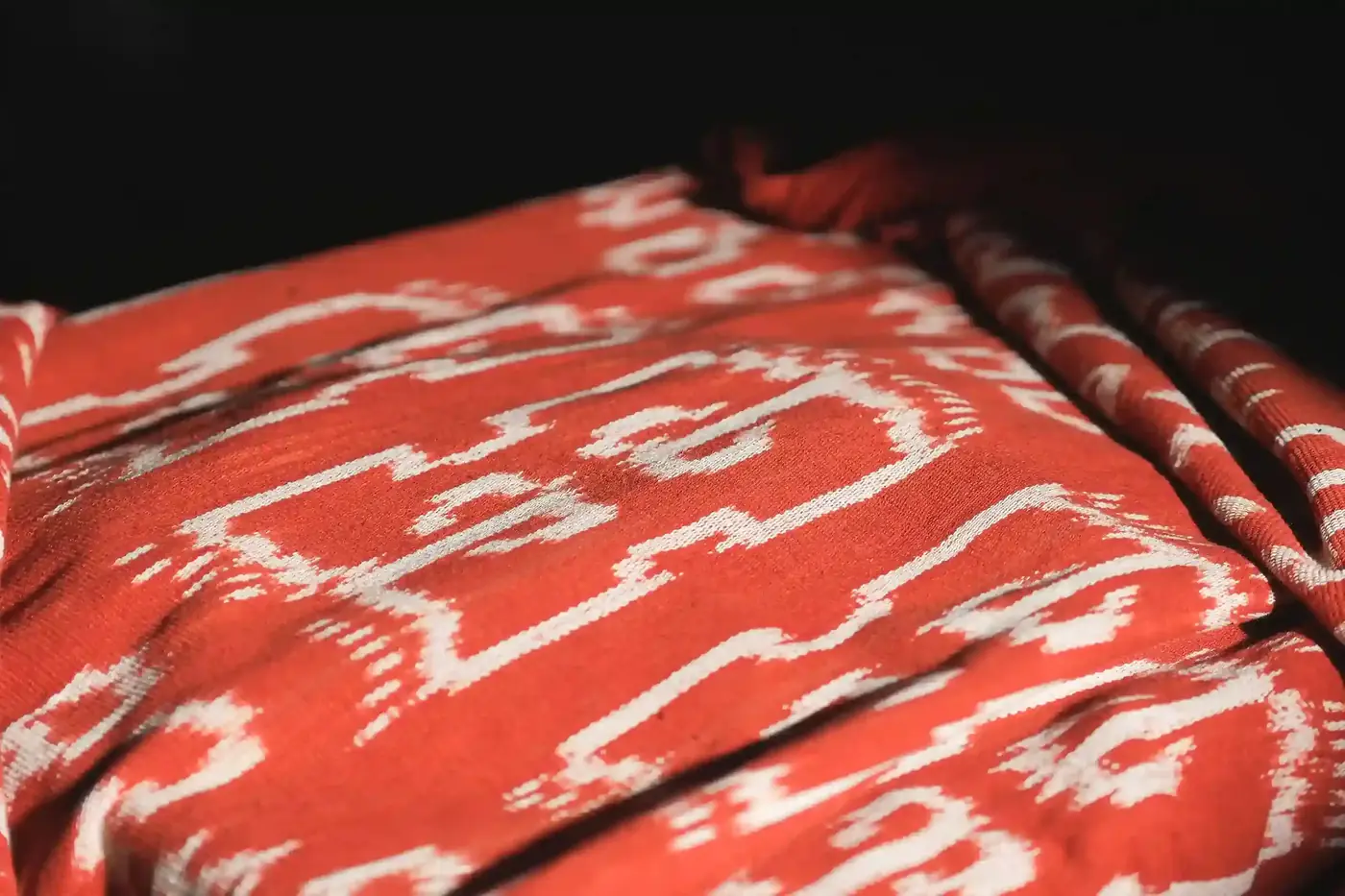
Wholesale Sumba ikat is quoted per finished piece rather than per metre, and the number on the quotation is driven by four variables: whether the cloth was dyed with natural or synthetic colourants, how fine the warp count is, how many separate dye baths the pattern required, and how many months the weaver spent tying and weaving it. Understanding those four variables is the difference between a buyer who negotiates well and a buyer who assumes every ikat panel of the same size should cost the same.
Why is Sumba ikat priced by the piece and not by the metre?
A classic Sumba hinggi is woven as two mirror-image panels on a backstrap loom and then joined along a centre seam, because the loom width limits how wide a single panel can be. The design is planned for that finished format, so cutting it into metres destroys the composition and the value. Wholesale programmes therefore price by piece for hinggi, lau, and panel goods, and shift to per-metre pricing only for plain or small-repeat yardage produced specifically for cutting. When you request a quotation, state clearly which of the two you need, because the two price structures are not interchangeable.
What actually sets the price of a piece?
Natural dyeing is the single largest cost multiplier in Sumba textiles. Red from morinda root requires an oil-and-mordant preparation before dyeing even begins, and deep tones are built through repeated immersions over an extended period; indigo blue is built the same way, dip by dip, with oxidation between dips. A cloth carrying both deep red and deep indigo has passed through two long dye programmes, not one. Beyond dye, the cost stack includes yarn quality, the number of motif rows tied by hand, the fineness of the warp, the skill grade of the weaver, and the end finishing — a hand-twined kabakil band at each end takes far longer than a machine-stitched hem.
Relative price bands buyers encounter
Absolute figures move with yarn cost, dye material availability, and order size, so the practical way to compare offers is by relative index rather than by memorised numbers. The table below uses a synthetic-dye workshop piece as the baseline of 1.0. Confirmed absolute pricing is issued per quotation against your specification.
| Tier | Typical characteristics | Relative index | Indicative production window |
|---|---|---|---|
| Workshop / synthetic dye | Machine-spun yarn, chemical dyes, repeatable motifs, consistent sizing | 1.0 | Weeks |
| Mixed dye | Natural indigo with synthetic accents, hand-tied warp, moderate motif density | 1.8 – 2.5 | Months |
| Full natural dye | Morinda red and indigo, dense motif rows, hand-twined ends | 4 – 8 | Many months |
| Master-grade / heirloom format | Finest warp, complex patola-derived registers, single weaver from start to finish | 10+ | A year or more |
How do minimum order quantities usually work?
Minimum order quantity in this category is set by weaver capacity, not by warehouse convenience. A village weaving group can only hold so many looms in production at once, so a large single-design order is filled over successive batches rather than in one drop. Practical wholesale structures therefore combine a modest per-design minimum with a larger blended minimum across the order. Buyers who need a real volume commitment should look at our sumba ikat wholesale programme, which is built around staged batches instead of a single impossible delivery date, and at handwoven textile wholesale terms if the order spans several cloth types at once.
Lead time: the clause most first orders get wrong
The most common friction point in a first wholesale order is a lead time copied from a garment supplier. Tying the warp resist for a dense motif field is done thread bundle by thread bundle before any dye touches the yarn, and it cannot be compressed by adding people to the loom. If your retail launch is fixed, work backwards from the natural-dye programme, not forwards from the purchase order date. Reorders of an existing design are faster than a first run of a new one, because the tying pattern already exists and does not have to be set out again.
Payment terms, deposits, and Incoterms
Because production is made-to-order and materials are bought upfront, wholesale terms in this category are normally deposit-based, with the balance settled against inspection photographs or a pre-shipment report before dispatch. Three points are worth writing into the order document rather than leaving to conversation:
- The Incoterm in full, with named place. EXW, FOB, and CIF allocate very different responsibilities for inland trucking within Indonesia, and Sumba is an island leg before the mainland leg.
- The tolerance for dimensional and colour variation. Handwoven cloth is not cut goods; a stated tolerance protects both sides from a dispute over a two-centimetre difference.
- The remedy for a rejected piece — replacement in the next batch, or credit — since a one-off handwoven piece cannot simply be pulled from stock.
What should a wholesale specification sheet contain?
A specification that prevents disputes covers six fields: cloth format and finished dimensions, dye class (full natural, mixed, or synthetic, stated explicitly), yarn type, motif register and permitted variation, end finishing, and packing method. Add photographic references of an approved sample and state whether the reference is a target or a strict match. For 2027 buying cycles, also confirm early whether you need each piece individually tagged for retail, because tagging and barcoding are finishing steps that must be scheduled into production rather than added at the port.
Frequently asked questions
Can I get identical repeats of the same ikat design?
Not identical in the industrial sense. Warp ikat produces feathered motif edges because the resist ties shift slightly during dyeing, so two pieces from the same pattern will read as a matched pair rather than as clones. Buyers who need strict uniformity across a large run should specify a synthetic-dye workshop tier and accept a simpler motif, while buyers selling on craft provenance usually treat the variation as the product’s proof of origin.
Is natural dye always the better commercial choice?
No. Natural dye carries a much longer production window and a higher landed cost, which suits collectors, galleries, and premium interiors. A café chain ordering forty table runners with a fixed opening date is usually better served by a mixed or workshop tier. The commercial mistake is not choosing synthetic dye; it is selling a synthetic-dye piece as a natural-dye piece.
How is quality checked before shipment?
Pre-shipment inspection for handwoven textiles covers dimensions against tolerance, seam alignment on joined panels, end-finish integrity, colour bleeding on a damp test, and a check for loom faults and skipped warps. Photographs of each piece, front and reverse, are the practical record, because in genuine warp ikat the motif appears on both faces with comparable clarity.
Do wholesale prices drop sharply with volume?
Less sharply than in mill-made textiles. Because the dominant cost is skilled hand labour rather than machine time, volume discounts in handwoven ikat are moderate and are usually expressed through better terms — staged deposits, consolidated freight, and priority in the production queue — rather than through steep unit reductions.
Request a wholesale quotation
Send your target cloth format, quantity, dye class, and delivery window and we will return a specification-based quotation with realistic batch dates. Message our sourcing desk on WhatsApp at https://wa.me/6281139414563 or email [email protected].
Related
Keep reading
Trade and Export
Textile Bulk Purchase Strategies for 2027 Buyers
A textile bulk purchase of handwoven Sumba cloth works best as a rolling order calendar spread across the year, not…

Trade and Export
Sumba Woven Fabric Market Overview for Traders
Sumba woven fabric sells into four distinct buyer segments — home retail, hospitality projects, fashion production, and collectors — and…
Trade and Export
Sumba Ikat Export Checklist 2027: Shipping & Docs
Exporting Sumba ikat from Indonesia requires three separate document sets, and a shipment stalls whenever one of them is treated…